Imaging spatially programmed energy release in ferroelectrics
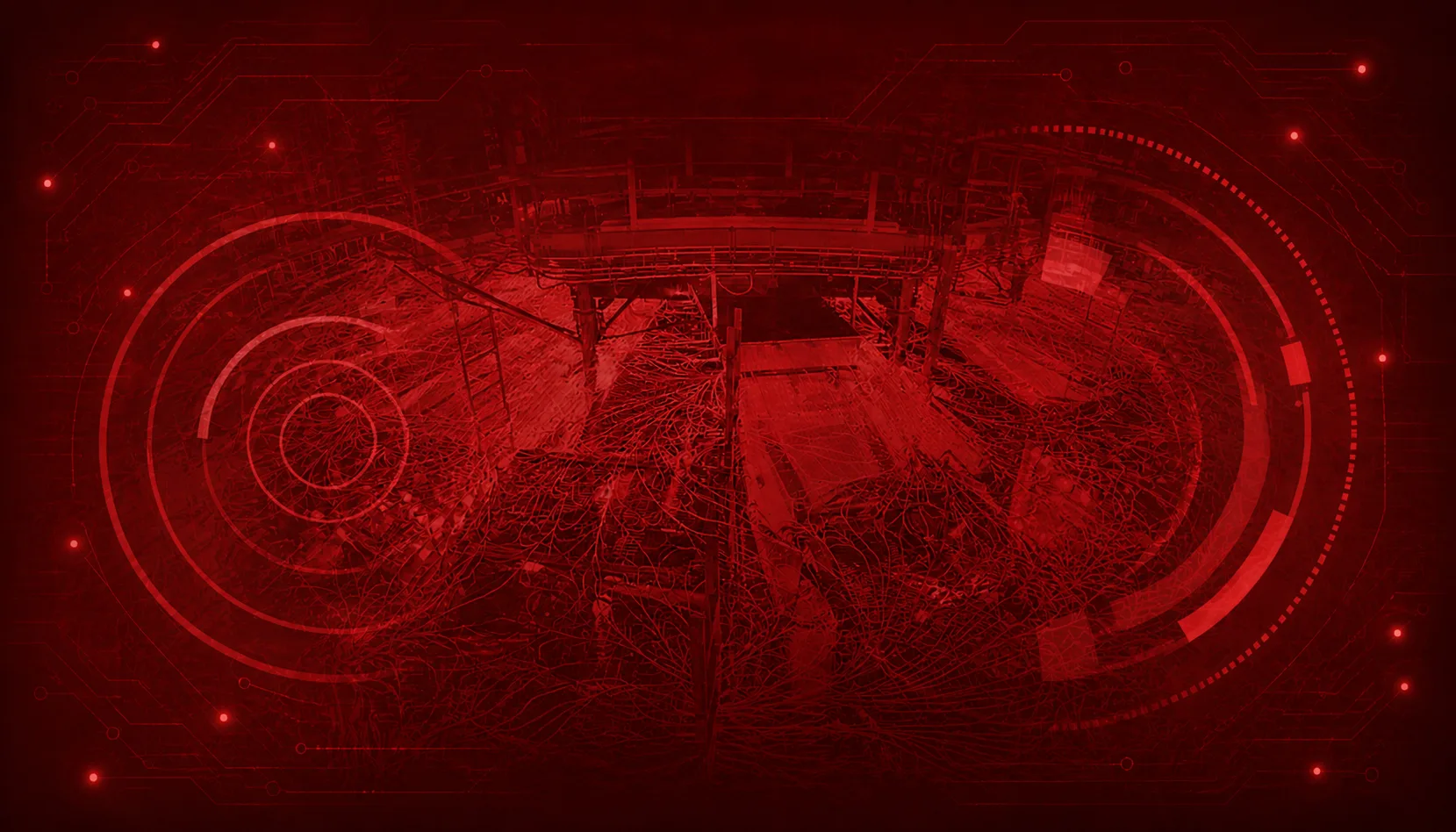
High-resolution imaging captures the spatial pattern of chemical energy release in ferroelectric energetics. Validating the theoretical mechanism.
Research Area
Theory only earns trust when it survives confrontation with measurement. CECD operates and partners with diagnostic platforms that resolve the fast, the small, and the hot, from sub-microsecond imaging of shock fronts to in-situ spectroscopy of decomposing energetics.
Time resolution
Spectroscopy
Imaging
Partner labs
Every diagnostic capability we support is paired with a computational counterpart, the goal is not measurement for its own sake but model validation, calibration, and discovery.
High-speed and ultra-high-speed imaging of reaction-front evolution in heterogeneous energetics. Refining initiation and growth models.
IR and Raman spectroscopy paired with quasi-harmonic and reactive-force-field calculations to validate vibrational mode predictions.
Real-time measurement during decomposition, deflagration, and shock loading. Paired with multiscale simulation.
Simulated and experimental frequency- and force-modulation AFM for soft samples and polymeric energetics.
Laser-induced breakdown spectroscopy for spatially resolved compositional mapping of energetic formulations.
Partner access to synchrotron and neutron beamlines for crystal-structure refinement and high-pressure phase studies.
Selected reports and collaborations where diagnostics drove the science, most published jointly with federal-laboratory partners.
High-resolution imaging captures the spatial pattern of chemical energy release in ferroelectric energetics. Validating the theoretical mechanism.
Diagnostics-grade IR pumping paired with non-equilibrium kinetic modeling reveals mode-resolved energy redistribution.
A simulation-experiment study guiding AFM contrast interpretation for polymer-bonded energetics.
CECD's diagnostic capabilities are organized as a partnership, the center brings simulation and analysis depth; sponsor and university partners contribute platforms.
Access to the Maryland NanoCenter, AIMLab, and FabLab for sample preparation and characterization.
Co-located experimental campaigns at federal energetics laboratories.
Sandia, LANL, and LLNL diagnostic platforms via active sponsored programs.
Tight loops between diagnostic teams and CECD's theory and computation groups.
Inquiries about sponsored research, graduate training, or technology transitions in this area can be directed to the center.